



Sample Barn-Farm Model for the Region, Type Animal Shelter and Clean Energy Production Application
Yapılış Tarihi | 28 August 2024, Wednesday

PROJECT NAME:
Model Barn-Farm for the Region & Type Animal Shelter & Clean Energy Production Application
PROJECT EXECUTOR:
Prof. Dr. Şenol GÜZEL
PROJECT TOPIC:
The topic of this project is to create a model farm operation in the Burdur region and to implement technological methods in cattle farming. By bringing together cattle breeding enterprises that are members of Agricultural Development Cooperatives in pilot-selected villages, a model operation suitable for Burdur's climate conditions and animal welfare will be established. The project aims to reduce labor and to ensure that cattle breeding is carried out in more modern and technological conditions instead of each breeder having their own tools and equipment. As a result, it will lead to a reduction in economic inputs and an increase in profit per animal through appropriate shelter, care, and feeding. Following the success in pilot villages, this model will be applied in other villages, leading to comprehensive development in cattle breeding in the Burdur region. This model will also serve as an example for cattle breeding enterprises on a national scale.
PROJECT OBJECTIVE:
In the European Community, the target number of milking cows per enterprise is set at 40, and if male calves are sold before 3 months, the number of animals at each age should be twice the number of cows, meaning the total number of animals should be 80. In our country, transforming such enterprises into commercial operations, establishing modern milking facilities, and constructing modern barn systems should be planned for at least 30 milking cows, thus allowing the use of technology in the development of enterprises. The only way to achieve this is by bringing together small-scale family enterprises. To give just one example; in Burdur, bucket mobile milking machines are generally used for milking, and although the electricity consumption of the machines is low, their high number leads to high power values, increasing energy consumption, causing power outages, and most importantly, extending the milking time, which results in cows not being milked at the appropriate time, causing a loss in yield. With the establishment of a modern enterprise model, there will be a significant increase in the number of cows per worker and the number of cows milked per unit time. This will also improve the quality of life for women who do the milking.
PROJECT'S REGIONAL CONTRIBUTION:
With the realization of the project; by ensuring connection and coordination with the Livestock Sector, it will contribute to solving the problems of the sector in the Burdur region.
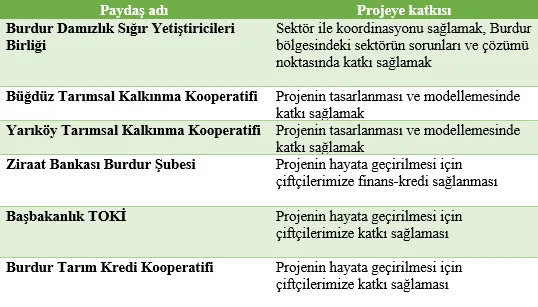
PROJECT'S SOCIAL CONTRIBUTION:
If the project is realized;
- It will serve as an example in terms of care, feeding, and milking,
- It will prevent the spread of diseases from one enterprise to another,
- Animals will be raised in conditions suitable for their welfare,
- Quality milk will be obtained as the milk will go directly to the cooling tank,
- Vaccination, medication, and disease control will be carried out uniformly,
- Manure obtained from animals will be collected and utilized in a single center (biogas, compost, heating, and electricity, etc.),
- With the implementation of modern herd management systems, pedigree and yield records of animals will be kept regularly, and as a result, superior productive animals will be identified and used in breeding, increasing the profit obtained per animal,
- The sale of animals produced for breeding to other commercial enterprises will lead to an overall increase in yield.
- It will be easier and more efficient to carry out all kinds of services (farmer training, application on animals, vaccination, etc.) provided by universities or official institutions to our farmers in a common place.
- By moving animal barns out of village and city centers, healthier living conditions will be provided for both animals and people. In short, this project will help small family enterprises to survive, increase the spirit of acting together and cooperativism, continue production, reduce production costs, increase the quantity and quality of products, and improve energy efficiency.